
AI in accounting: what to hand over and what to keep
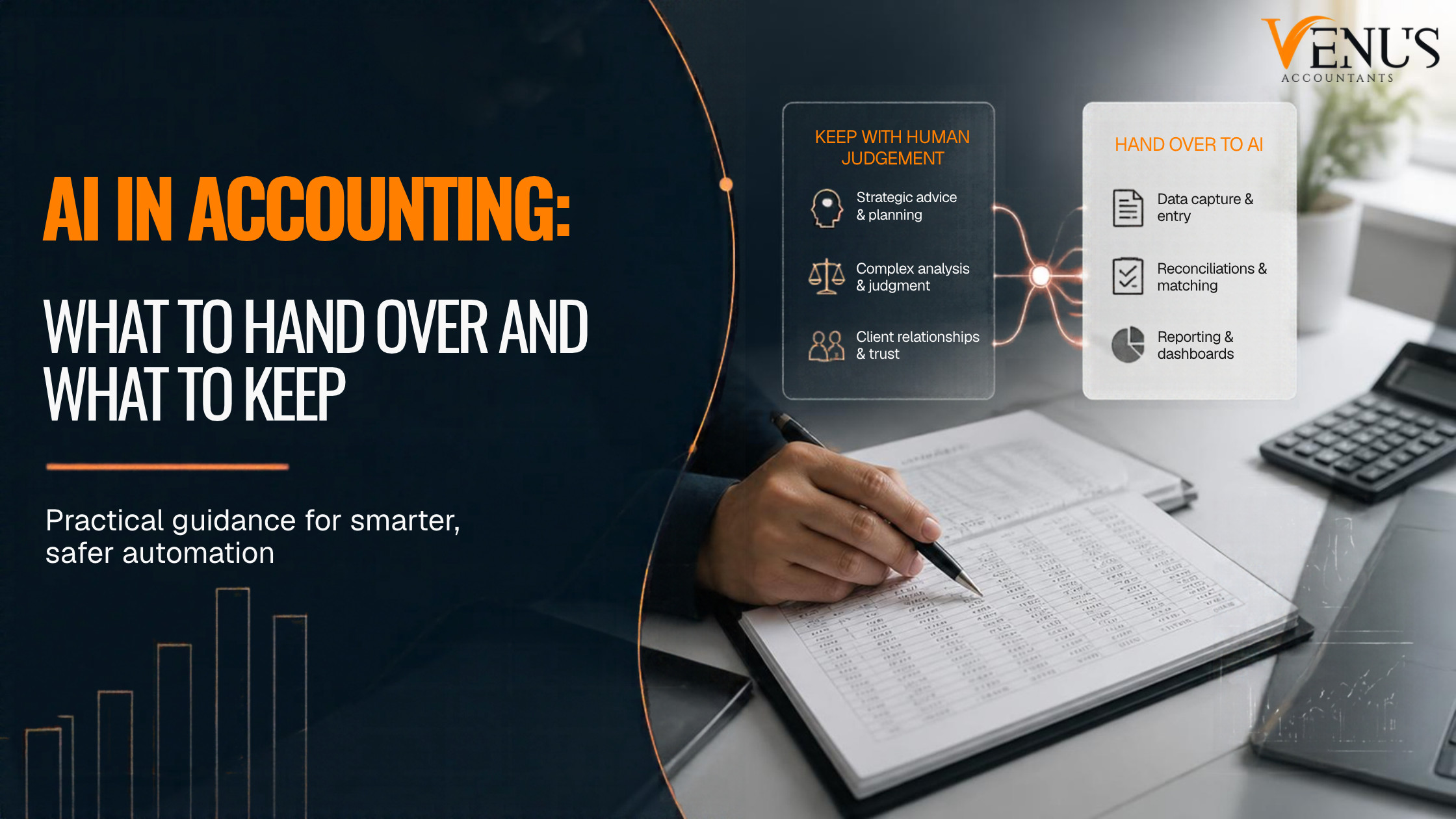
Every practice is being asked the same question this year: where should AI sit in the work? The honest answer about AI in accounting is narrower than the marketing and more useful than the warnings. AI earns its place on tasks whose output you can check in seconds. It is a liability on tasks whose output you cannot check without redoing the work.
This guide sets out where the line falls in an Australian tax, SMSF or bookkeeping practice, what the Tax Practitioners Board now expects, how to tell whether AI is saving time or quietly adding review, and a short policy you can adopt this week.
Where AI earns its place today
The pattern behind every good use of AI for accountants is the same: the task is clearly defined, the person using the tool already knows what a correct result looks like, and checking takes less time than doing. Five examples that pass that test in most practices:
- Client document requests and reminders. Give it the list of what is outstanding and let it draft the email. Check: it asks only for what is missing, in your practice's tone, with no made up deadlines.
- Meeting notes into action lists. Paste the notes, ask for owners and dates. Check: nothing was invented and nothing was dropped. Thirty seconds against the notes.
- First drafts of procedure notes and checklists. A rough description of how a tax return, a fund file or a BAS moves through the practice becomes a clean draft to edit. Check: the steps match what your people actually do.
- Spreadsheet formulas on sample data. Ask for the formula, then test it on three rows where you already know the answer before it touches a client file.
- Training. Explaining a concept to a junior, building a practice scenario, turning an ATO page into a plain summary that is then read against the ATO page itself.
Notice what these have in common. None of them produces a number that goes to a client. They remove typing, not judgement.
Where professional judgement must stay in control
Tax positions. A model will give you a confident, well structured answer that cites a rule that does not apply to this client, this year, or this entity type. The failure is invisible unless you already know the answer. The test is simple: if you cannot point to the ATO page or the legislation yourself, the answer is not yours to give.
SMSF compliance assessment. Sole purpose, related party transactions, pension minimums and in house asset limits turn on the fund's deed, its records and its circumstances. A tool that has not seen the documents is guessing, and the auditor will not accept a guess.
Reconciliations. A standalone AI tool cannot access your bank feed or ledger unless you provide the records or connect it to your systems. AI can help identify potential differences, but an accountant must investigate the cause, verify the supporting evidence and confirm the reconciliation is complete.
Anything with client identifiers in a consumer tool. Names, TFNs, bank details and financial statements entered into a free chat tool may be stored and reviewed by the provider, depending on its terms. That is a confidentiality question before it is an efficiency question, and the next section is why.
What the TPB expects
On 22 July 2026 the Tax Practitioners Board released its guidance statement on the use of AI by tax practitioners, TPB(GS) 55/2026. It does not create new obligations. It explains how the existing Code of Professional Conduct applies when AI is in the workflow, and its position is plain: practitioners remain accountable for the services they provide, and AI is a tool to support professional judgement, not replace it.
The guidance points to the Code items that matter most: competence, reasonable care, confidentiality, record keeping, professional judgement, and supervision and control. Three practical consequences follow.
- Confidentiality (Code item 6). You may not disclose a client's affairs to a third party without permission. Entering client information into an AI tool can be a disclosure to that provider, depending on how the tool stores and uses what you type. Check the tool's terms, use business tiers with data controls, and check what your engagement letter actually permits.
- Reasonable care. AI output that goes into a return or a set of accounts has to be verified against the source, the same as a junior's work. "The tool said so" is not a position.
- Record keeping. Where AI shaped a conclusion, keep the evidence that a person read it, tested it and decided. Blindly copying output into a client file is the thing the TPB is warning about.
Read the statement itself. It is short, and it is the document a reviewer will hold you to.
Measure the whole job, not the draft
Most AI accounting time savings are measured at the wrong point. A draft that took twenty minutes instead of an hour looks like a win. If the reviewer then spends forty minutes reconstructing where the figures came from, correcting a treatment and sending it back, the practice has lost time and gained risk.
Measure completed jobs: preparation time plus review time plus rework, from file open to file out. Compare the same job type with and without the tool over a month. Keep the uses where the completed job got faster and the review points did not rise. Drop the rest without sentiment.
One more cost that does not show up on a timesheet: the junior who never prepares a reconciliation never learns what a wrong one looks like. Preparation work is how accountants build judgement. Keep people doing it.
A six line AI policy for a practice
- Name the approved tools and the approved tasks. Anything not on the list is not approved.
- No client identifiers in consumer tools. Business tiers with data controls only, and only after someone has read the terms.
- Every technical output is verified against the source before it is relied on: the ATO page, the legislation, the records.
- The preparer must be able to explain the reasoning without the tool.
- Where AI influenced advice, keep the prompt, the output and the review note on the file.
- Review the policy every quarter. The tools and their terms change faster than the Code does.
Where people still do the work
Everything in the judgement section is preparation: working through the records, reconciling, investigating differences, building workpapers that a reviewer and an auditor can follow, answering review points. That work still needs trained people with time, and it is where most practices are short.
That is the part Venus does. Our offshore accountants prepare tax returns, SMSF files, accounts and bookkeeping inside your systems and to your standards, with every file checked by a senior reviewer before it reaches you. AI can take the typing out of your week. Capacity takes the rest. If that is the gap in your practice, the taxation, SMSF and bookkeeping pages explain how the work flows.


